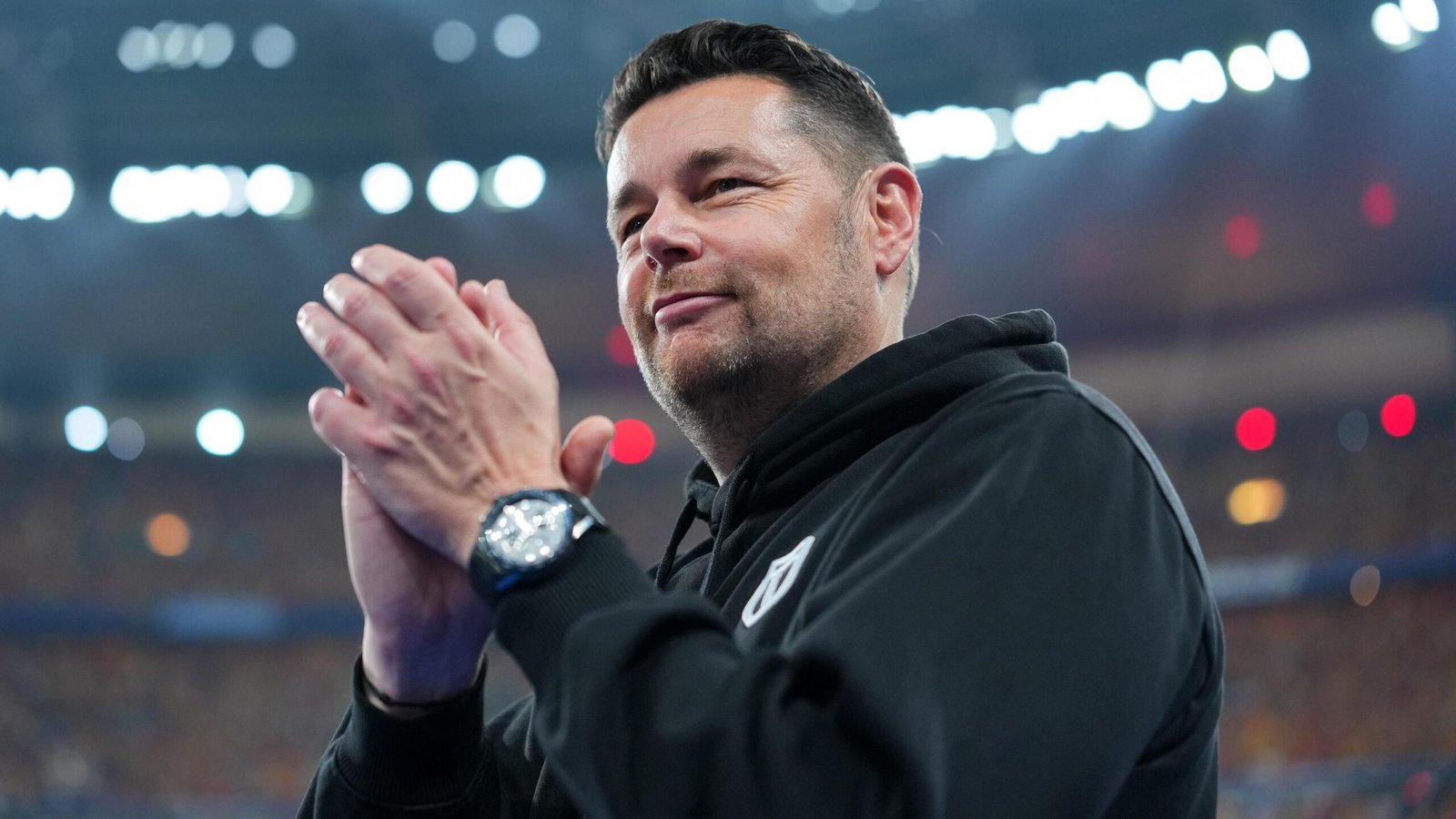
Pierre Sage looks set to become the next Crystal Palace manager, and on paper, it appears to be one of the smartest appointments of the summer.
The French tactician is reportedly closing in on a move to Selhurst Park after a remarkable campaign with Ligue 1 side RC Lens.
He guided Les Sang et Or to a second-place finish in Ligue 1 and lifted the Coupe de France.
While replacing Oliver Glasner is no easy task, Palace’s hierarchy seems to have identified a coach whose philosophy mirrors many of the principles that helped deliver success in south London.
The most obvious reason why Sage makes sense is tactical continuity.
Glasner, who might be off to AC Milan, built Palace around a 3-4-2-1 shape that maximised the strengths of key players across the squad.
Rather than forcing a radical rebuild, Sage arrives with a strikingly similar system.
At Lens this season, he predominantly used a 3-4-3 formation, creating a structure that could defend aggressively while remaining dangerous in transition.
That tactical alignment makes him the perfect tactical fit.
Palace are preparing for another campaign involving European football, and avoiding a complete stylistic overhaul reduces disruption.
Players already comfortable operating in a back three should adapt quickly to Sage’s methods.
The numbers suggest Palace supporters should also expect an exciting brand of football.
Lens were among Ligue 1’s most effective pressing teams despite not dominating possession.
Their average possession figure of 51.9% ranked only eighth in the division, highlighting a side that prioritised efficiency over sterile ball retention.
Instead, Sage’s team excelled at winning the ball in dangerous areas and attacking quickly.
Lens recorded 69 shots following high turnovers, the second-highest total in Ligue 1. They scored seven goals from those situations, ranking joint-fourth in the division.
These figures show a team capable of turning defensive pressure into immediate attacking opportunities.
The transition statistics are arguably even more impressive.
Lens ranked first in Ligue 1 for fast breaks with 55 and also led the league with eight goals from those attacks.
They generated 47 shots from fast breaks, the third-best total in the division, while their 65 direct attacks ranked third overall.
Those numbers paint a clear picture. Sage’s teams are proactive, vertical and ruthless when space opens up.
However, this is not a reckless press-at-all-costs approach. The data suggests Lens pressed with intelligence rather than constant aggression.
Opponents were allowed to hold possession before specific pressing triggers were activated.
That controlled approach helped Lens avoid defensive chaos while still recovering possession in advanced areas. It is not the all-out frantic approach of, say, Andoni Iraola.
Results ultimately matter most, and Sage has delivered them wherever he has gone.
His Lens side accumulated 70 points from 34 league matches, winning 22 games and losing only eight. They also secured the club’s first Coupe de France title in its 120-year history.
Across spells with Lyon and Lens, Sage has compiled an impressive win rate of around 67.5%.
For Crystal Palace, this looks like the ideal blend of continuity and ambition.
Sage has a familiar tactical framework and has shown he can develop competitive teams. The 47-year-old brings a modern, high-energy style that should excite supporters.
Replacing Glasner was always going to be difficult, but Palace may have found the closest possible fit.
Stats from Opta